Response Style and Validity Assessment in Peace Officer Fitness-for-Duty Evaluations: Detecting Over- and Under-Reporting in a High-Stakes Context
Instructor: Sepideh Souris, PsyD
This course is approved for California POST Continuing Professional Education credit.
Course Description
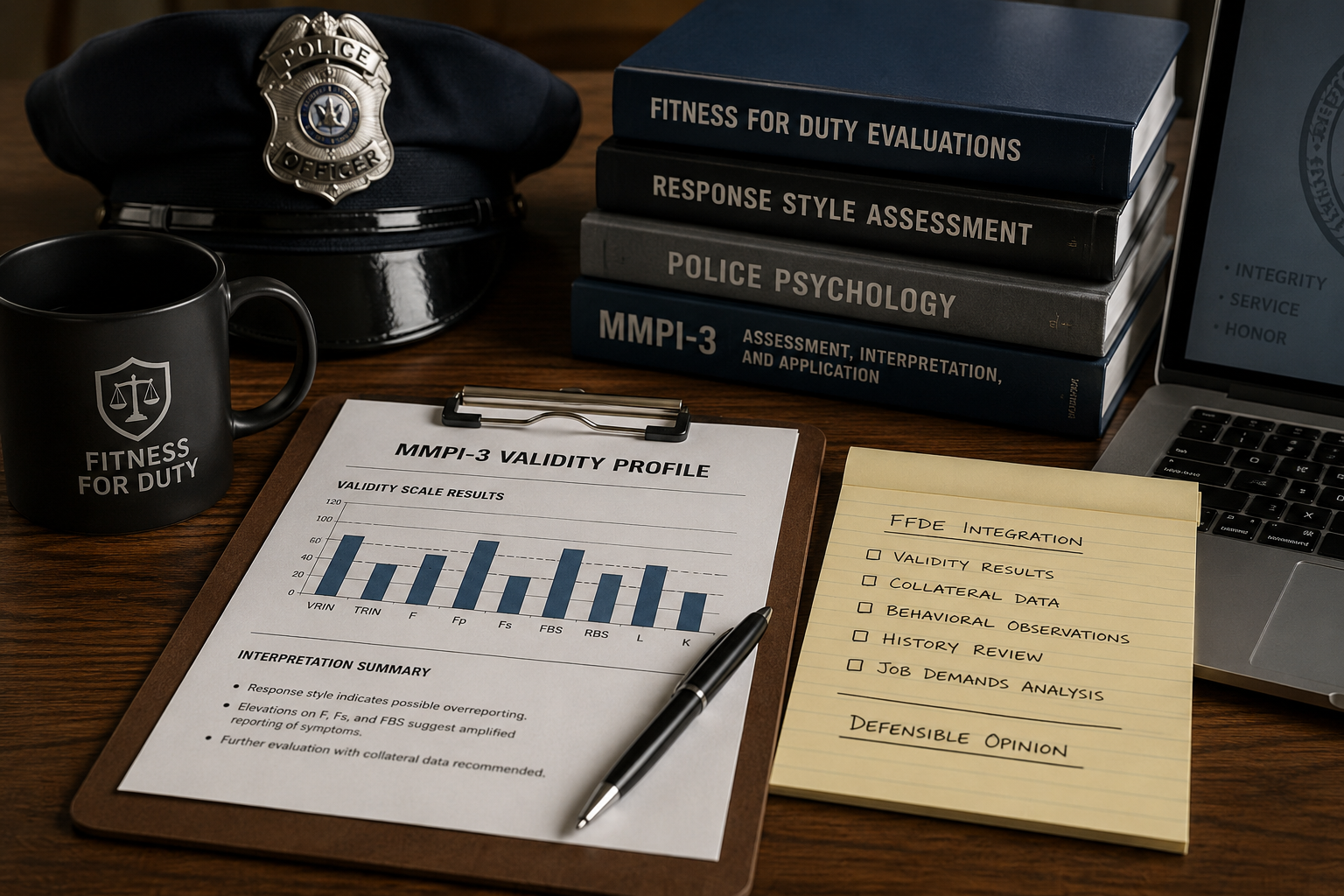
This 3-hour program provides an in-depth examination of response style assessment and protocol validity within peace officer fitness-for-duty evaluations (FFDEs), with particular focus on the bidirectional incentive structures that distinguish FFDEs from clinical and preemployment contexts. Participants will develop a working command of MMPI-3 validity scales, their empirical foundations, and their configurational interpretation in adversarial, high-stakes settings. The program emphasizes the integration of validity findings with collateral data to produce defensible fitness opinions.
Program Goals
Building upon doctoral-level training in psychological assessment, psychopathology, and forensic psychology, this program extends participants' competencies into the specialized domain of occupational validity assessment for public safety personnel. It deepens the practitioner's ability to apply advanced psychometric reasoning—specifically MMPI-3 validity scale interpretation—within the unique legal, ethical, and contextual demands of fitness-for-duty evaluation, a practice area that doctoral training addresses only broadly.
Learning Objectives
After completing this course, participants will be able to:
- Identify the MMPI-3 validity scales associated with content non-responsiveness, over-reporting, and under-reporting, and distinguish the specific construct each scale is designed to detect
- Describe the bidirectional incentive structure unique to fitness-for-duty evaluations and explain how it differs from the unidirectional incentive structure typical of preemployment psychological screening
- Differentiate between content non-responsive invalidity and content-based invalidity in terms of their origins, implications, and appropriate evaluator responses when each is detected
- Apply a configural interpretation strategy to MMPI-3 validity scale patterns in fitness-for-duty evaluation contexts, integrating scale elevations with referral context, behavioral observations, and collateral information to reach a defensible validity determination
- Analyze the evidentiary limitations of substantive MMPI-3 scale scores obtained under conditions of invalid responding, and explain the implications of protocol invalidity for fitness-for-duty conclusions in contested administrative or legal proceedings
📄 Downloadable course materials included
Course Outline
- 1Section 1: The Fitness-for-Duty Evaluation as a Unique Assessment Context (25 minutes)
- 2 - Why the FFDE is not a clinical evaluation: the shift from diagnosis to functional capacity
- 3 - The non-confidential, high-stakes, adversarial context and its structural implications for self-report
- 4 - Why honest responding is an empirical question in FFDEs, not a safe assumption
- 5 - Legal and professional framework: ADA standards, business necessity, and evaluator independence
- 6Section 2: Why Validity Is the Foundation, Not a Preliminary Step (30 minutes)
- 7 - How an invalid protocol contaminates every substantive inference that follows
- 8 - Content non-responsive invalidity versus content-based invalidity: distinct phenomena with different implications
- 9 - What the MMPI-3 manual requires before substantive scales are interpreted
- 10 - The "clean profile" problem: why unremarkable scores without valid responding are uninterpretable
- 11Section 3: The Bidirectional Incentive Structure Unique to Fitness Evaluations (30 minutes)
- 12 - Over-reporting: the continuum from mild exaggeration to feigning and its multiple possible explanations
- 13 - Under-reporting: the continuum from ordinary impression management to rigid denial
- 14 - Why detecting a response style is not the same as explaining its motive
- 15 - The "virtuous victim" pattern: simultaneous exaggeration and minimization in disability and litigation contexts
- 16Section 4: The MMPI-3 Validity Scales in Depth (50 minutes)
- 17 - Content non-responsiveness indicators: CNS, VRIN, TRIN, and CRIN
- 18 - Over-reporting scales: F, Fp, Fs, FBS, and RBS and what distinguishes each layer of detection
- 19 - Under-reporting scales: L and K and how naïve versus sophisticated defensiveness present differently
- 20 - Configural interpretation: reading scale patterns rather than isolated scores in the FFDE context
- 21 - Evidence base for each scale family: forensic disability samples, simulation research, and public safety populations
- 22Section 5: Integrating Validity Data with Collateral and Behavioral Evidence (30 minutes)
- 23 - When an invalid protocol shifts the evaluator to non-self-report data sources
- 24 - Using records, behavioral observations, and collateral interviews as convergent or divergent evidence
- 25 - How validity findings are documented and reported in the FFDE context
- 26 - Maintaining defensible conclusions when self-report and collateral data conflict
- 27Section 6: Professional and Forensic Defensibility Under Scrutiny (15 minutes)
- 28 - Anticipating cross-examination on validity determinations
- 29 - Common evaluator errors: premature motive attribution, unidirectional vigilance, and conflating response style with diagnosis
- 30 - Bidirectional vigilance as both a scientific and ethical obligation
- 31 - Integrating validity conclusions into the fitness opinion without overreaching the data
About the Instructor

Sepideh Souris, PsyD
- Professional Degree & Discipline:
- PsyD
- Current Position & Expertise in Program Content:
- Dr. Sepideh Souris is a forensic and police psychologist with more than two decades of leadership experience in public sector psychological services. For 21 years, she served as the Chief of Psychological Services for the Los Angeles County Psychological Services Unit (PSU), where she also held the role of Senior Human Resources Manager, overseeing Occupational Health Programs, disability management, and compliance. In this capacity, she directed pre-employment, occupationally mandated evaluations and disability management operations for all 40 County departments and commissions, including the full spectrum of public safety evaluations such as Psychological Fitness for Duty examinations and specialized assessments for law enforcement and safety sensitive personnel. Dr. Souris has provided expert testimony in more than 25 Civil Service Commission matters and in multiple cases before the Los Angeles County Superior Court. She has delivered extensive training on pre employment psychological evaluations, fitness for duty evaluations, threat assessment, and workplace violence prevention. At the request of the U.S. Department of State, she presented on pre employment psychological evaluation practices for law enforcement personnel at the 4th International Conference in Mexico City. Her professional work also includes a private forensic practice focused on FFDEs, appeals, IMEs, and specialized forensic evaluations. She is the author of the chapter “Integration of Internet Based Data in Pre Employment and Fitness for Duty Psychological Evaluations in the Law Enforcement Arena,” published in Forensic Mental Health Evaluations in the Digital Age, reflecting years of applied experience and consultation with national experts. Dr. Souris currently serves as the Manager of the Behavioral Threat Assessment and Management Team for Los Angeles County and is an active member of the Association of Threat Assessment Professionals. She has held academic appointments as an assistant clinical professor at the UCLA Geffen School of Medicine and as adjunct faculty at Pepperdine University and California State University, Fullerton.
Conflict of Interest Disclosure
No commercial support or conflicts of interest to disclose.
Refund & Cancellation Policy
Full refund available within 7 days of purchase if course has not been started. No refund after course content has been accessed.

Mindset Continuing Education is approved by the American Psychological Association to sponsor continuing education for psychologists. Mindset Continuing Education maintains responsibility for this program and its content.
Need accessibility accommodations? Request them here →