Telehealth-Administered Preemployment Psychological Evaluation of Peace Officers: Equivalence, Limitations, and Defensible Practice
Instructor: Bahar Safaei-Far, PsyD
This course is approved for California POST Continuing Professional Education credit.
Course Description
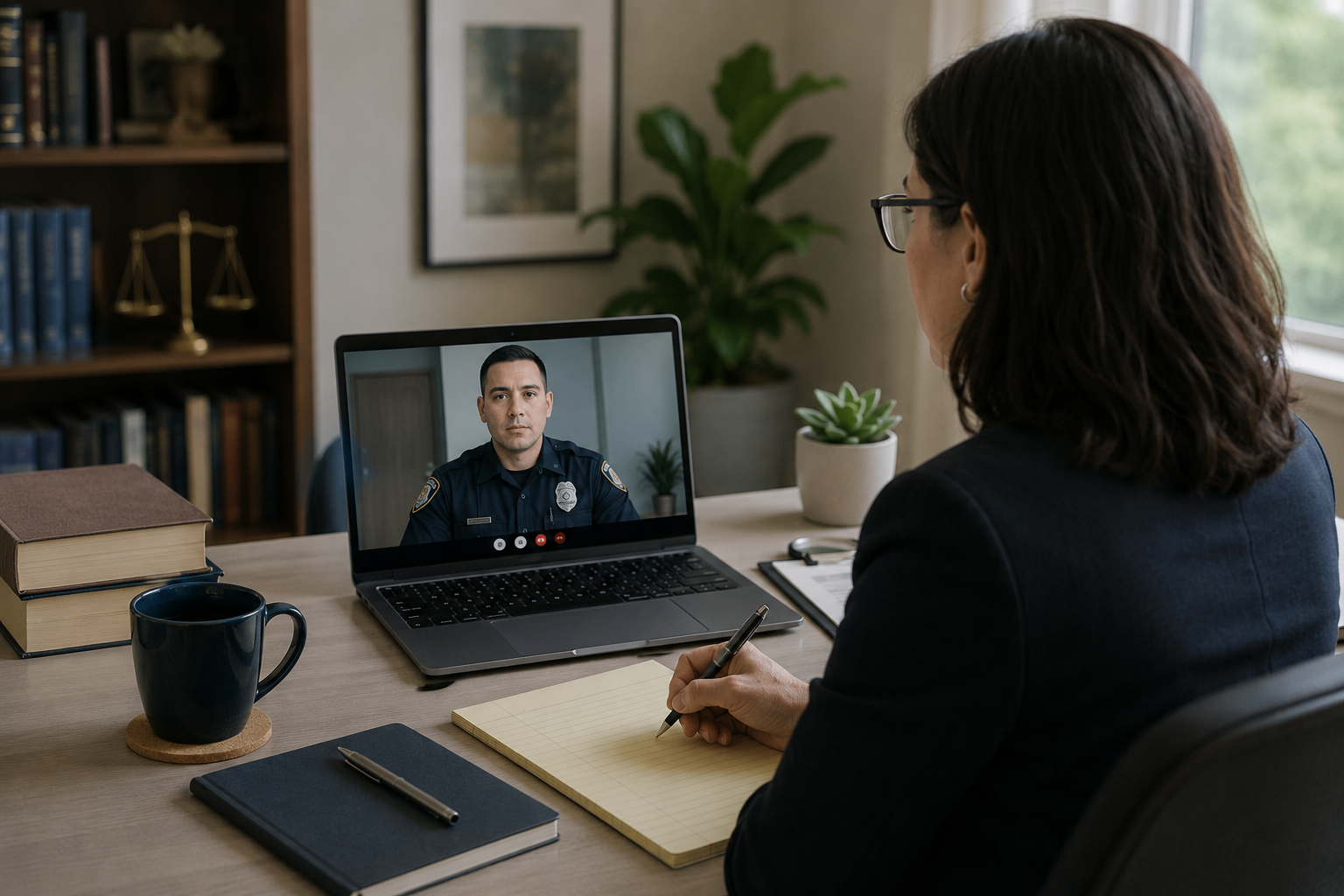
This 3-hour continuing education program examines the psychometric equivalence, documented benefits, and limitations of telehealth-administered preemployment psychological evaluations for peace officer candidates under California POST requirements. Participants will analyze the evidence base component by component—covering remote test administration, proctoring, clinical interviewing, and records review—and translate that analysis into defensible, standards-compliant practice. The program integrates guidance from APA telepsychology guidelines, APA Division 41 recommendations, and IACP guidelines to support evaluators in making professionally grounded modality decisions.
Program Goals
Building on doctoral training in psychological assessment, psychopathology, and professional ethics, this program advances participants' competency in applying emerging teleassessment research to a specialized high-stakes forensic context. It extends foundational assessment knowledge by addressing the distinct evidentiary, procedural, and regulatory demands of remote delivery in public safety selection, equipping evaluators to critically appraise the literature, identify the boundaries of current evidence, and document modality-related decisions in a legally and professionally defensible manner.
Learning Objectives
After completing this course, participants will be able to:
- Identify the components of a preemployment psychological evaluation that are differentially affected by remote versus in-person delivery modality
- Describe the current state of psychometric equivalence evidence for remote administration of the MMPI-2-RF and MMPI-3 in peace officer candidate populations
- Distinguish between the equivalence of measurement properties across administration modalities and the broader question of preemployment screening effectiveness
- Apply relevant professional guidelines — including APA telepsychology guidelines, APA Division 41 recommendations, and IACP guidelines — to evaluate the defensibility of specific remote evaluation protocols under California POST requirements
- Analyze the limitations of the current teleassessment evidence base, including gaps in instrument-specific research and the relative absence of remote clinical interview equivalence data, when making component-level decisions about remote evaluation procedures
📄 Downloadable course materials included
Course Outline
- 1Section 1: Scope, Context, and the Regulatory Landscape (30 minutes)
- 2 - Overview of preemployment psychological evaluation requirements under California Government Code § 1031(f) and POST Commission Regulation 1955
- 3 - Historical shift from in-person to remote evaluation: pre-pandemic niche use versus post-pandemic normalization
- 4 - Telehealth evaluation as a composite procedure: distinguishing test administration, proctoring, clinical interview, and records review
- 5 - Governing professional standards: APA telepsychology guidelines, APA Division 41 recommendations, and IACP guidelines
- 6Section 2: The Equivalence Evidence for Remote Test Administration (45 minutes)
- 7 - Foundation in computerized administration research: MMPI format equivalence across decades of validation
- 8 - Police-candidate specific findings for the MMPI-2-RF and MMPI-3 across in-person and remote conditions
- 9 - Validity scale functioning under remote administration: implications for detecting defensive and invalid responding
- 10 - Corroborating evidence from forensic, clinical, and Veterans Affairs teleassessment studies
- 11Section 3: Benefits and Documented Drawbacks of Remote Delivery (30 minutes)
- 12 - Access, cost, and scheduling advantages: evidence from the broad telehealth outcomes literature
- 13 - Alliance concerns and why they apply least to brief, structured assessment encounters
- 14 - Self-report personality inventories as the assessment type best suited to remote delivery
- 15 - Real cautions: security challenges, digital divide, and limits of the evidence base for non-self-report instruments
- 16Section 4: Boundaries of the Evidence and Known Limitations (30 minutes)
- 17 - Concentration of equivalence findings in the MMPI family and implications for multi-method batteries
- 18 - The research gap for remote clinical interview equivalence versus remote test administration
- 19 - Proctoring as a separable variable: synchronous, asynchronous, and absent supervision conditions
- 20 - Distinguishing measurement equivalence across modality from the separate question of screening effectiveness
- 21Section 5: Environmental Control, Test Security, and Defensible Administration Protocols (30 minutes)
- 22 - Standardization requirements derived from APA telepsychology principles and test manual conditions
- 23 - Practical controls for the remote testing environment: space, device, connectivity, and prohibited materials
- 24 - Synchronous video proctoring procedures and documentation of administration conditions
- 25 - Addressing breaches, irregularities, and the decision to invalidate or repeat an administration
- 26Section 6: The Remote Clinical Interview: Observations, Limitations, and Compensatory Strategies (15 minutes)
- 27 - What is lost in video-mediated clinical observation: behavioral cues, proxemics, and environmental context
- 28 - Structuring the remote interview to preserve reliability and coverage of POST screening dimensions
- 29 - Compensatory strategies: structured questioning, collateral data weighting, and extended record review
- 30 - Documentation requirements when interview modality may affect the weight of observational findings
- 31Section 7: Access, Accommodation, Adverse Impact, and Defensible Practice Integration (30 minutes)
- 32 - Post-offer timing and ADA obligations: how modality intersects with accommodation and access requirements
- 33 - The digital divide in practice: connectivity, device adequacy, private space, and digital literacy barriers
- 34 - Offering remote delivery as an option while preserving in-person alternatives for candidates for whom telehealth creates barriers
- 35 - Documentation, consent, and report language that supports a defensible suitability determination across modalities
About the Instructor

Bahar Safaei-Far, PsyD
- Professional Degree & Discipline:
- PsyD
- Current Position & Expertise in Program Content:
- Dr. Bahar Safaei-Far provides clinical and forensic psychological services to attorneys throughout the Southwest, including the states of Nevada, Utah, Arizona, New Mexico, Texas, and Colorado. Dr. Safaei-Far's professional services include psychological consultation, psychodiagnostic testing, Fitness-for Duty evaluations, expert reports, and expert witness testimony in the areas of immigration law, employment law, criminal law, and civil law, including negligence law. As a forensic psychology expert, Dr. Safaei-Far has worked collaboratively with lawyers in hundreds of cases in California and throughout the Southwest. Her cogent testimony and expert reports communicate clearly about issues related to mental status and emotional functioning. A U.S. Navy veteran, Dr. Safaei-Far is experienced in providing and managing the delivery of psychological services to veterans and their families in crisis. For the California Department of Corrections and Rehabilitation (CDCR), she performed evaluations for the courts and managed the clinical operations of a crisis unit that delivered services to special population parolee clients, including sex offenders, substance abusers, arsonists, inmates who had been veterans, and dually diagnosed men and women. Dr. Safaei-Far has extensive experience in conducting psychological Fitness for Duty Evaluations (FFDE) with respect to any security or safety-related position, for both public and private entities. In addition to Fitness for Duty Evaluations, Dr. Safaei-Far also performs psychological screenings and risk assessment evaluations for return-to-work clearances in any safety or security-related employment environment. Additionally, Dr. Safaei-Far has extensive knowledge of California's Peace Officer Standards and Training (POST) requirements. She is qualified as a POST evaluator, and performs evaluations on a case-by-case basis for law enforcement appeals and other positions governed under POST requirements.
Conflict of Interest Disclosure
No commercial support or conflicts of interest to disclose.
Refund & Cancellation Policy
Full refund available within 7 days of purchase if course has not been started. No refund after course content has been accessed.
Mindset Continuing Education is approved by the American Psychological Association to sponsor continuing education for psychologists. Mindset Continuing Education maintains responsibility for this program and its content.
Need accessibility accommodations? Request them here →