Personality Assessment Instruments in Peace Officer Preemployment Screening: Comparative Validity, Normative Bases, and Defensible Use
Instructor: Troy Ewing, Psy.D.
This course is approved for California POST Continuing Professional Education credit.
Course Description
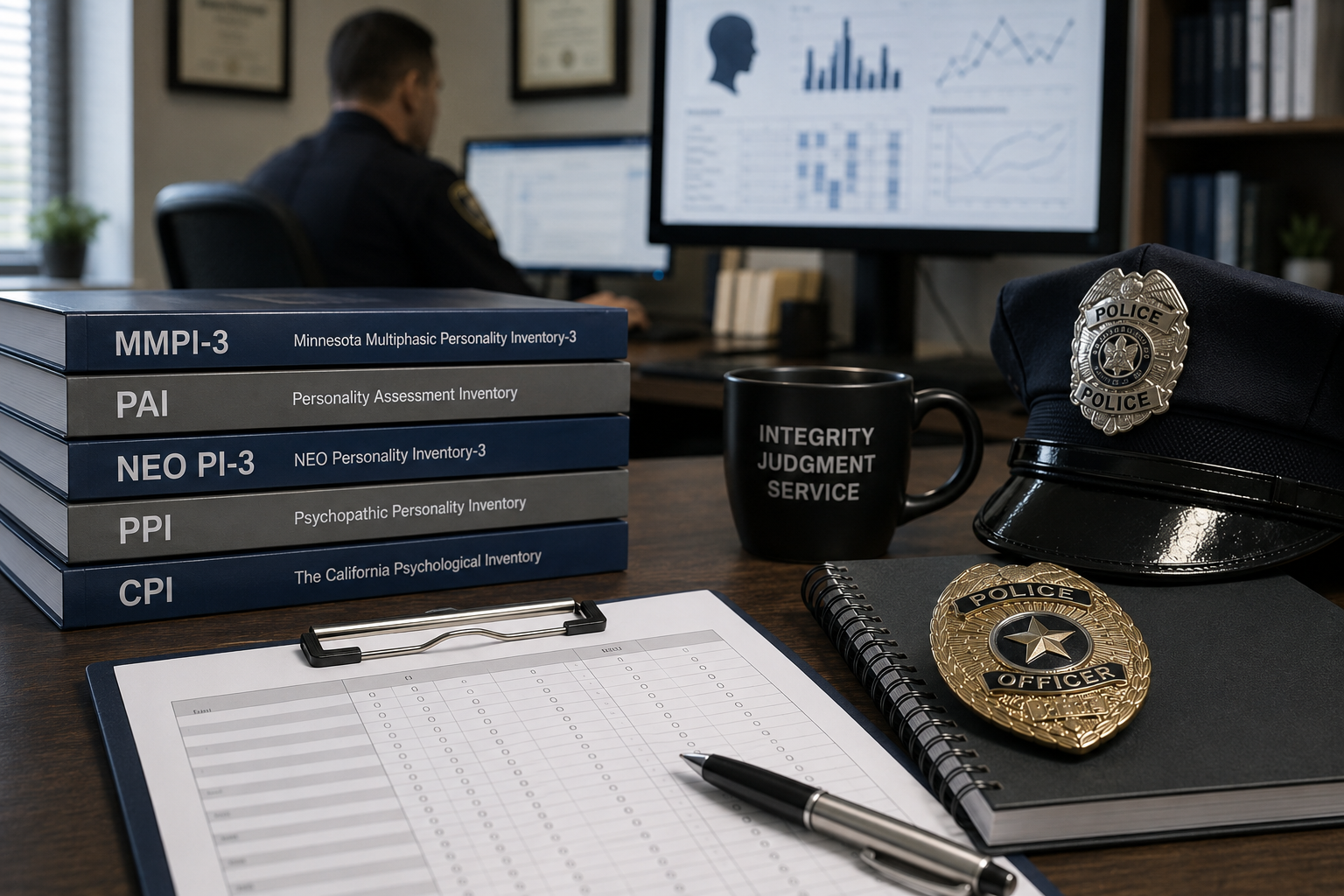
This 4-hour continuing education program provides an evidence-based comparative analysis of personality assessment instruments used in California POST preemployment psychological screening evaluations. Participants examine clinical and normal-range instruments against six defensibility criteria—including public-safety-specific norms, criterion validity, incremental validity, and response-distortion detection—within the regulatory framework established by Government Code § 1031(f) and POST Commission Regulation 1955. The program addresses instrument selection, response validity interpretation, and the convergence model for integrating testing, interview, and background investigation data into suitability determinations.
Program Goals
This program builds upon doctoral training in psychological assessment by extending foundational psychometric principles into the specialized domain of public safety preemployment evaluation. Where doctoral education establishes general competencies in test selection, validity interpretation, and clinical decision-making, this program refines those competencies for the distinctive demands of a screen-out selection context: restricted-range validity interpretation, candidate-referenced normative comparison, legally defensible instrument justification, and multi-source data integration across the POST psychological screening dimensions.
Learning Objectives
After completing this course, participants will be able to:
- Identify the regulatory requirements governing California POST preemployment psychological evaluations, including the specific competencies outlined in Commission Regulation 1955
- Explain the screen-out logic of the peace officer preemployment evaluation and distinguish it from a screening-in model, including how normal-range deficits constitute disqualifying concerns in their own right
- Apply the six evaluative criteria for instrument selection—public-safety-specific normative base, sample size and representativeness, criterion validity, incremental validity, response-distortion detection, and fairness evidence—to assess the defensibility of instruments used in a preemployment battery
- Compare the MMPI-3 and PAI on evidentiary depth, public-safety-specific normative bases, criterion validity, and response-distortion detection for use in peace officer preemployment screening
- Describe the strengths and limitations of normal-range personality instruments, including the MPQ, in detecting disqualifying personality characteristics relevant to the POST psychological screening dimensions
- Analyze how demonstrated underreporting on validity scales changes the weight assigned to substantive scale elevations and other data sources within a multi-instrument battery
- Explain how convergence of correlates across standardized testing, clinical interview, and background investigation supports a defensible suitability determination within the screen-out model
📄 Downloadable course materials included
Course Outline
- 1Section 1: Regulatory Framework and the Logic of the Battery (40 minutes)
- 2 - California POST mandate: Government Code 1031(f) and Commission Regulation 1955
- 3 - The screen-out model: presumption of suitability and the search for disqualifying evidence
- 4 - Why two instrument types are required: clinical and normal-range measures detect different concerns
- 5 - Convergence as the basis for weighting: how correlates across testing, interview, and background investigation establish concern
- 6Section 2: Criteria for Evaluating Instruments in This Context (35 minutes)
- 7 - Public-safety-specific normative base and why community norms are the wrong reference group
- 8 - Criterion validity in honest perspective: range restriction, noisy criteria, and realistic expectations
- 9 - Incremental validity: whether an instrument adds information beyond what is already captured
- 10 - Response-distortion detection and fairness evidence as requirements, not optional features
- 11Section 3: Clinical-Range Instruments Compared (45 minutes)
- 12 - The MMPI-3 and MMPI-2-RF: normative base, validity scale architecture, and criterion validity evidence in public-safety populations
- 13 - Public-safety candidate comparison norms and why candidate-referenced scores differ from community-referenced scores
- 14 - The PAI: scale structure, validity indicators, predictive validity evidence, and the role of defensive responding
- 15 - Comparative evidentiary depth: basis for instrument selection and documentation of the rationale
- 16Section 4: Normal-Range Instruments Compared (45 minutes)
- 17 - The MPQ: higher-order dimensions, primary trait scales, and alignment with POST screening dimensions
- 18 - Candidate norms, recent validity work, and the instrument's growing role in public-safety selection
- 19 - Other normal-range instruments in current use: evidence base, normative considerations, and defensibility
- 20 - Selecting and pairing instruments: what the incremental-validity evidence supports
- 21Section 5: Response Distortion, Fairness, and Legal Defensibility (30 minutes)
- 22 - How the selection context produces systematic underreporting and what the research demonstrates
- 23 - Validity scale interpretation: distinguishing careless responding from motivated impression management
- 24 - Differential validity and fairness evidence across demographic groups
- 25 - Legal and professional standards bearing on instrument selection and documentation
- 26Section 6: Integrating the Battery: From Data to Determination (45 minutes)
- 27 - The integration model: convergence of concern across testing, interview, and background investigation
- 28 - How demonstrated underreporting changes the weight assigned to self-report versus collateral sources
- 29 - Translating instrument findings into the POST psychological screening dimensions
- 30 - Documenting defensible determinations: articulating instrument choice, data weight, and conclusions
About the Instructor
Troy Ewing, Psy.D.
- Professional Degree & Discipline:
- Psy.D.
- Current Position & Expertise in Program Content:
- Dr. Troy Ewing is a licensed clinical psychologist and CEO of Ewing Diagnostic & Psychological Services, Inc., a multi-site practice providing psychological and forensic assessment services across California and beyond. With over two decades of experience, Dr. Ewing specializes in pre-employment psychological evaluations, forensic assessments, and disability-related evaluations for local, state, and federal agencies. He has extensive experience working with law enforcement and government organizations, including managing large-scale psychological screening programs for correctional and public safety personnel. His expertise includes the administration and interpretation of a wide range of psychological and cognitive assessment instruments, as well as comprehensive report writing for diagnostic, eligibility, and risk-assessment purposes. n addition to his clinical and forensic work, Dr. Ewing is the founder of Mindset Continuing Education, an APA-approved provider, where he develops and delivers continuing education programs for mental health professionals. His career also includes significant experience in correctional mental health, university counseling, and crisis intervention, where he has worked with diverse populations across clinical settings. Dr. Ewing earned his Doctor of Psychology (Psy.D.) in Clinical Psychology from the California School of Professional Psychology and is licensed in multiple states.
Conflict of Interest Disclosure
No commercial support or conflicts of interest to disclose.
Refund & Cancellation Policy
Full refund available within 7 days of purchase if course has not been started. No refund after course content has been accessed.
Mindset Continuing Education is approved by the American Psychological Association to sponsor continuing education for psychologists. Mindset Continuing Education maintains responsibility for this program and its content.
Need accessibility accommodations? Request them here →