Understanding the Scope and Factors for Suicide Risk in Peace Officers and Public Safety Personnel
Instructor: Troy Ewing, Psy.D.
Course Description
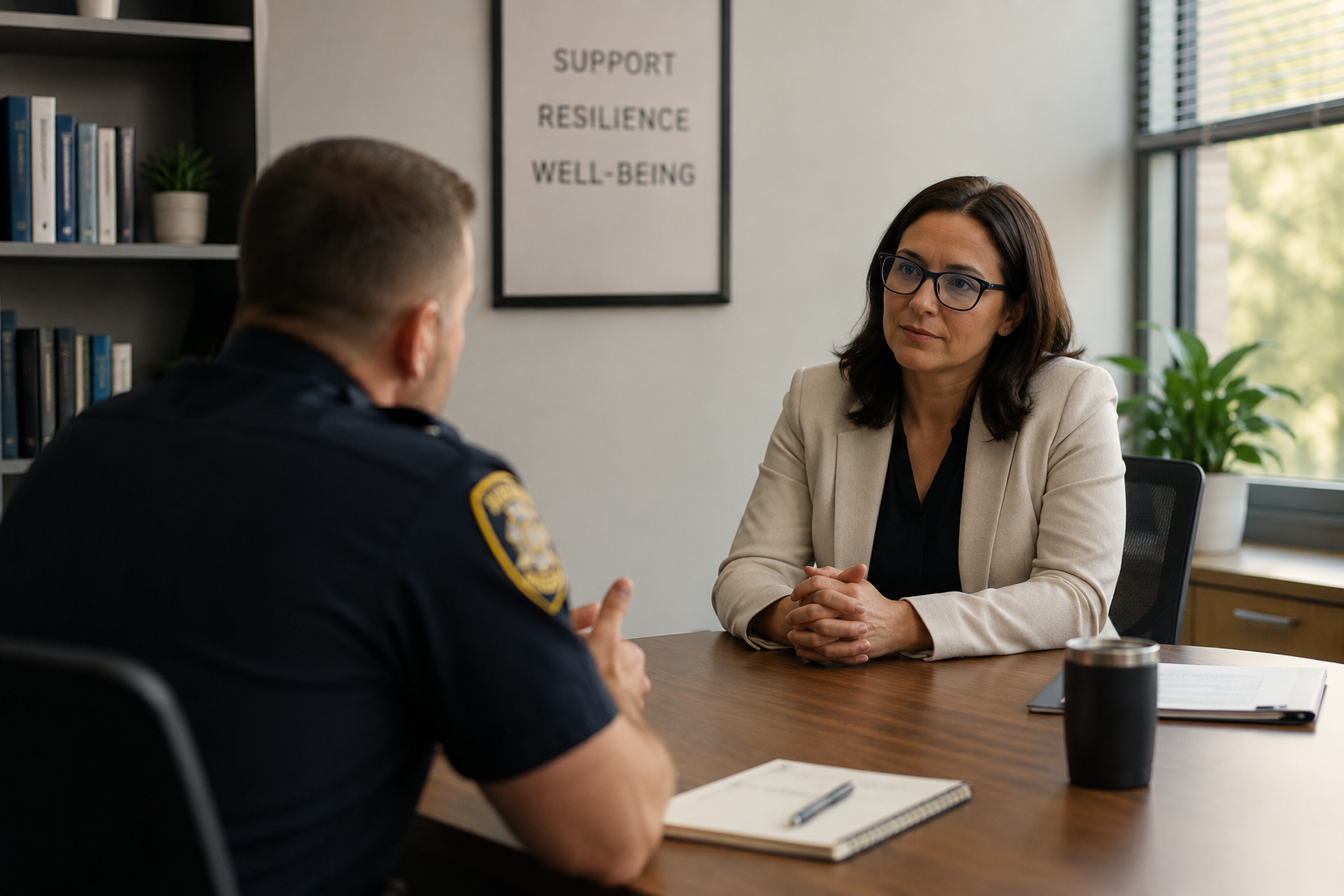
This course fulfills California's mandated 6 hours of continuing education in suicide assessment and intervention, with a specialized focus on peace officers and public safety personnel. Participants will examine the epidemiology of suicide in law enforcement, the occupational risk stack that elevates baseline risk, and evidence-based clinical frameworks for assessment and intervention with this population. Emphasis is placed on the intersection of occupational stressors, physiological consequences of cumulative trauma, and culturally competent clinical engagement.
Program Goals
Building upon foundational doctoral training in psychological assessment, psychopathology, and evidence-based intervention, this program extends competency into a specialized clinical population whose occupational context meaningfully alters standard risk formulation models. Participants will integrate knowledge of neuroendocrine stress responses, interpersonal theory of suicide, and occupational health research into their existing clinical skill sets, equipping them to conduct more accurate and population-informed suicide risk assessments with peace officers and public safety personnel.
Learning Objectives
After completing this course, participants will be able to:
- Identify the distinct occupational categories within the peace officer and public safety personnel population and explain how each group is represented in the suicide research literature
- Describe the methodological challenges that contribute to underestimation of suicide rates among peace officers, including misclassification of deaths and retirement-era data gaps
- Analyze how components of the occupational risk stack, including shift work, sleep deprivation, cumulative trauma exposure, alcohol use, and relationship strain, interact to compound suicide risk in peace officers
- Explain the physiological mechanisms by which cumulative trauma exposure and cortisol dysregulation contribute to elevated suicide risk in law enforcement personnel
- Distinguish between suicide risk factors that are common to the general population and those that are structurally embedded in peace officer occupational roles
- Apply the occupational risk stack framework to a composite clinical presentation in order to formulate elevated suicide risk in a peace officer client
- Assess the clinical implications of firearm availability as a structural risk factor for peace officers, including the unique tensions between means restriction and professional requirements
Course Outline
- 1Section 1: The Scope of Suicide in Peace Officers and Public Safety Personnel (45 minutes)
- 2 - Defining the population: peace officers, public safety personnel, and correctional officers
- 3 - Prevalence data and comparison to line-of-duty deaths
- 4 - Suicidal ideation rates and the gap between need and service utilization
- 5 - Methodological challenges: under-reporting, misclassification, and retirement-era suicides
- 6Section 2: The Occupational Risk Stack — Structural and Physiological Factors (50 minutes)
- 7 - Shift work, circadian disruption, and long-term health consequences
- 8 - Sleep deprivation as an independent suicide risk factor and its neurological mechanisms
- 9 - Cumulative trauma exposure and cortisol dysregulation across career timelines
- 10 - Firearm access as a structural component of occupational means availability
- 11Section 3: The Occupational Risk Stack — Behavioral and Social Factors (40 minutes)
- 12 - Alcohol use prevalence, occupational stress as a driver, and compounding interactions with other risk factors
- 13 - Relationship strain, marital stress, and the distinction from civilian populations
- 14 - Social network narrowing and the erosion of civilian support structures
- 15 - Intersection of social isolation with interpersonal theories of suicide
- 16Section 4: Integrating the Risk Stack — A Clinical Framework for Formulation (45 minutes)
- 17 - How occupational exposures compound rather than add across a career
- 18 - Recognizing the cumulative clinical picture versus single acute stressor models
- 19 - Applying the risk stack to case conceptualization with peace officer clients
- 20 - Introduction to interpersonal theory constructs as applied to this population
- 21Section 5: Federal Data Infrastructure and Reporting Landscape (20 minutes)
- 22 - Law Enforcement Suicide Data Collection Act of 2020 and its limitations
- 23 - CDC National Occupational Mortality Surveillance database as a primary evidence source
- 24 - Current gaps in data collection for correctional officers and retired personnel
- 25 - Implications for clinicians interpreting prevalence estimates in practice
- 26Section 6: Clinical Implications and Course Orientation (20 minutes)
- 27 - Why general suicide risk models require adaptation for peace officer populations
- 28 - Overview of subsequent modules and competencies addressed
- 29 - Orienting the clinician to the tension between clinical safety and professional viability
- 30 - Reflective practice: assumptions clinicians bring to law enforcement clients
About the Instructor
Troy Ewing, Psy.D.
- Professional Degree & Discipline:
- Psy.D.
- Current Position & Expertise in Program Content:
- Dr. Troy Ewing is a licensed clinical psychologist and CEO of Ewing Diagnostic & Psychological Services, Inc., a multi-site practice providing psychological and forensic assessment services across California and beyond. With over two decades of experience, Dr. Ewing specializes in pre-employment psychological evaluations, forensic assessments, and disability-related evaluations for local, state, and federal agencies. He has extensive experience working with law enforcement and government organizations, including managing large-scale psychological screening programs for correctional and public safety personnel. His expertise includes the administration and interpretation of a wide range of psychological and cognitive assessment instruments, as well as comprehensive report writing for diagnostic, eligibility, and risk-assessment purposes. n addition to his clinical and forensic work, Dr. Ewing is the founder of Mindset Continuing Education, an APA-approved provider, where he develops and delivers continuing education programs for mental health professionals. His career also includes significant experience in correctional mental health, university counseling, and crisis intervention, where he has worked with diverse populations across clinical settings. Dr. Ewing earned his Doctor of Psychology (Psy.D.) in Clinical Psychology from the California School of Professional Psychology and is licensed in multiple states.
Conflict of Interest Disclosure
No commercial support or conflicts of interest to disclose.
Refund & Cancellation Policy
Full refund available within 7 days of purchase if course has not been started. No refund after course content has been accessed.

Mindset Continuing Education is approved by the American Psychological Association to sponsor continuing education for psychologists. Mindset Continuing Education maintains responsibility for this program and its content.
Need accessibility accommodations? Request them here →